

The Srebrna Góra Fortress, an immense 18th-century stronghold in the mountains of Lower Silesia, Poland, remains one of Europe's greatest feats of military engineering. Covering over 106 hectares, the complex featured storerooms, armories, a chapel, hospital, prison, bakery, brewery, and more. Designed to be entirely self-sufficient, it once housed over 3,700 soldiers. Yet one element was absolutely critical to its survival during prolonged sieges: access to drinking water. To secure it, workers dug wells plunging as deep as 80 meters into the bedrock—a staggering effort that, according to some sources, doubled the overall construction cost of the fortress. Today, these wells, along with the sprawling submerged corridors they connect to, remain the most enigmatic parts of the Silver Mountain stronghold.
In 2024, a new chapter of exploration began. A team from the Submerged Foundation, supported by the XDEEP Exploration Support Program, launched an ambitious mission to explore and document the fortress's nine massive wells and hidden tunnels, blending cutting-edge 3D scanning technologies with the spirit of underwater archaeology. "The more inaccessible a place is, the more it calls to me. For people like me, cave diving feels like a superpower," said project lead Marcin Stempniewicz. Securing permission to dive the fortress was no easy feat. The Submerged Foundation's impressive track record, including 3D mapping of the Maria Concordia mine and photogrammetry of archaeological sites in Croatia, ultimately paved the way. For the first time since the 1980s, divers were given access to these submerged corridors, untouched for decades.
The team's first target was the well beneath the old fortress brewery. Historical plans indicated the presence of a tunnel, previously partially explored during dives in the 1980s. Equipped with sturdy and trusted sidemount systems from XDEEP, perfect for underwater work in tight restrictions, as well as the new explorers-grade SL:01 drysuits from SEAL Drysuits and finally armed with GoPro cameras and powerful lights, Marcin Stempniewicz led the initial descent into the darkness. "Every bubble I exhaled brought down clouds of silt from the ceiling. It was like diving inside a snow globe someone kept shaking," he recalled.
Despite near-zero visibility, the divers successfully navigated into the tunnel, confirming its alignment with old maps and documentation. The rough-hewn stone soon gave way to a neatly brick-lined corridor, hinting at careful engineering. Back on land, the team studied historical maps of the fortress. The tunnel, it turned out, extended under the moat and beyond. Reaching the corresponding structure on the far side of the moat proved an adventure of its own. Battling thick undergrowth and scrambling down rocky slopes with ropes, the team found a forgotten casemate embedded in the counterscarp wall. "Getting there wasn’t half the adventure, climbing through bushes, dangling on ropes, all to find a square well hidden in the counterscarp," said Michał Antoniuk, a Submerged Foundation cave diver. Inside the casemate, they found a vertical shaft unlike the fortress’s typical wells: narrow, square, and partly filled with rubble.
To explore the tunnel more safely, the team deployed an underwater ROV (remotely operated vehicle). Unfortunately, the drone's cable became hopelessly tangled in decades-old metal debris. "Our great plan for a robotic survey quickly turned into a rescue mission. In the end, I had to dive in myself to save the drone," as Marcin recalls. "I remember I was already out of my drysuit, drinking hot tea and trying to get warm after a previous dive. When they told me I had to jump right back into the cold black hole, I could only laugh and get ready." Realizing underwater exploration was too hazardous, they hatched a bold idea: pump the tunnel dry. After meticulous planning with fortress custodian Grzegorz Basiński, they installed a high-capacity pump. Removing the metal grate that had fallen into the well decades earlier was the first step. Ultimately, they pumped out approximately 120 cubic meters of water, revealing a tunnel that had not been seen dry in centuries.
Walking through the dry tunnel transformed the team's understanding. Underwater, the passage seemed to twist unpredictably. Dry, it was almost perfectly straight. Shelf-like niches, likely for oil lamps, lined the walls. At the tunnel's end, they confirmed the existence of a vertical shaft, though filled with debris and unreachable for now.
To definitively prove the tunnel's connection between the brewery well and the casemate, the team improvised a simple but ingenious test: blasting loud music from a giant speaker placed inside the counterscarp. Sure enough, the team standing on the opposite side of the fortress could hear the sound clearly.
Beyond the brewery, the team turned their attention to the fortress's central tower, the Donjon. Dives here yielded no ancient treasure, just a lost smartwatch, but a more profound discovery awaited. On the well's walls, they found a neatly carved inscription reading "AWE," alongside another marking that might be Cyrillic. The team 3D-scanned the inscriptions and even printed scaled models for historians to study.
The Srebrna Góra project is far from over. Three wells have been explored. A fourth has been probed with a camera. Five remain untouched. Each descent into the fortress’s depths could reveal new layers of forgotten history.
"If these hidden tunnels taught us anything, it's that the fortress still has secrets waiting to be uncovered," said Michał Antoniuk during one of his public talks about the exploration project.
Through their work, the Submerged Foundation is not only breathing life back into an 18th-century marvel but also showing that, beneath the surface of history, mystery still waits for those willing to dive deep.
I’ve always been most interested in what’s off the beaten track. The more inaccessible, the better. For people like me, cave diving is like having a superpower.
Marcin Stempniewicz, Explorer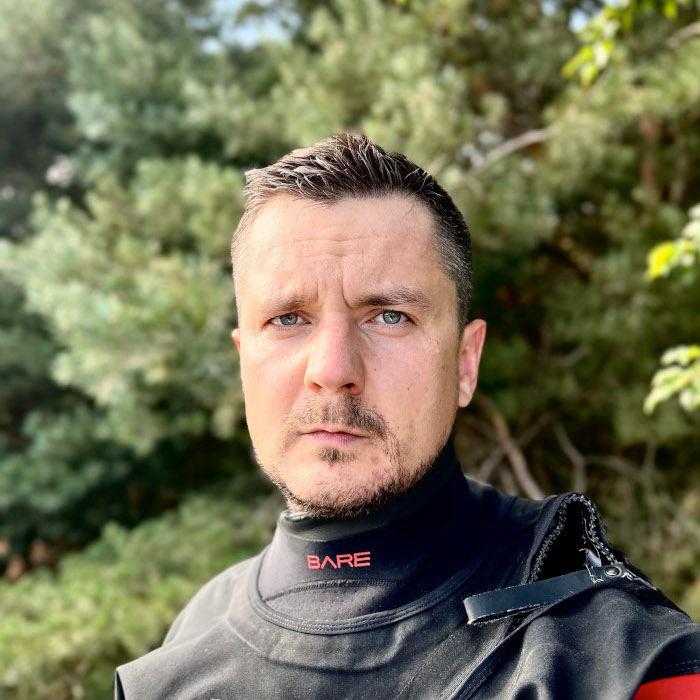
05.2024 - ongoing

It's your contribution!
By choosing the brands involved in our program for your personal diving, you directly contribute to the support we can provide to ESP divers around the world. Every little bit counts towards reaching our goals.
Thank you!
How to apply?
Share your vision with us. We want to support adventures, explorations, and projects that deepen the understanding of the underwater world.


